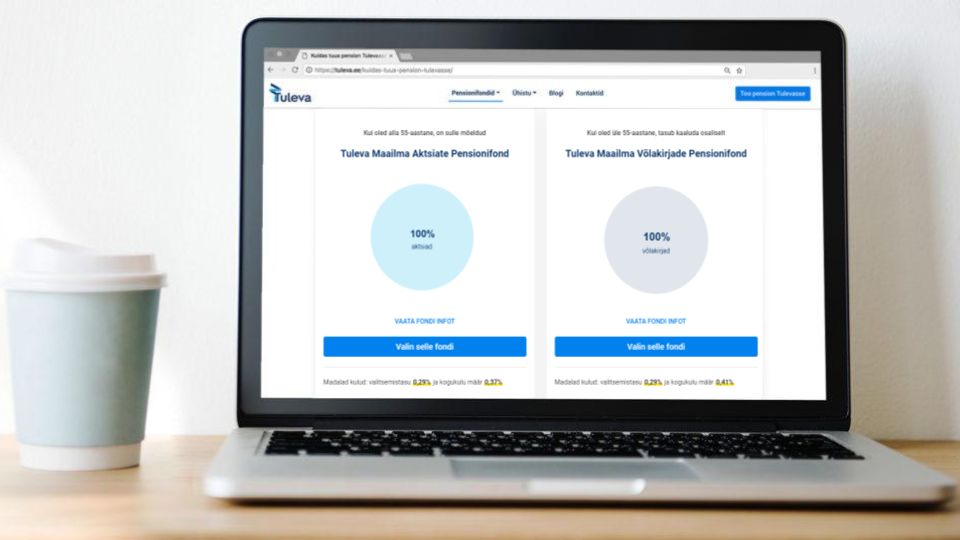
In spring 2016, 22 Estonian entrepreneurs and public figures made a promise to one another: to help make pension saving more affordable for people in Estonia. We established Tuleva.
The birth of better pension funds was made possible by the 3,000 Tuleva members who teamed up with the founders right from the first months. Today, the dream is a reality. More than 84,000 savvy people are already saving for their future with Tuleva’s modern, low-fee Pillar II and Pillar III funds.
If you work in Estonia, you’re most likely already saving in Pillar II. (1) You can save 2%, 4% or 6% of your gross salary in Pillar II, income tax-free. On top of your own contribution, the state adds 4% of the social tax to your Pillar II. (2) Choose a low-fee index fund today, because the less you pay in fees, the more you’ll have left for the future (in Estonian). Choose a Tuleva fund, because the more people save for their pension together, the more affordable it becomes for all of us.
If you only have a minute,
here’s what I’d say:
Tuleva is good for you.
Tuleva’s pension funds are among the most affordable in Estonia: the ongoing charges, i.e. your total cost as a saver, are currently 0.28% a year. We have lowered our fees consistently, and as our assets grow, we will keep doing so.
Tuleva is as safe as a bank fund.
Tuleva’s savers of course have all the same rights and guarantees as savers in banks’ pension funds. We are supervised by the Financial Supervision Authority, and savers’ assets are always kept separate from the fund manager’s money at the depositary bank, which is SEB. In addition, the state Guarantee Fund protects investors in all Pillar II pension funds against the worst. Find out more at pensionikeskus.ee (in Estonian).
Tuleva World Stocks Pension Fund
This is a low-fee global index fund that invests entirely in stocks. Its return can swing sharply from year to year. Even so, its expected return is significantly higher than that of a bond fund.
It suits you if you want to achieve the best long-term return and don’t plan to withdraw your entire Pillar II within the next 5 years. Most Tuleva members and founders save in this fund.
Tuleva World Bonds Pension Fund
This is a conservative index fund that invests entirely in low-risk bonds. Its expected return is significantly lower than that of a stock fund. A good return just isn’t possible with low risk.
It suits you if you plan to withdraw your entire Pillar II within the next 5 years and are willing to give up returns for the sake of certainty.
Transferring your Pillar II to Tuleva is free and only takes a couple of minutes.
Transfer my Pillar II to Tuleva
A closer look: what’s inside Tuleva’s funds?
Tuleva’s funds have low fees and invest, according to clear rules, in the stocks of the world’s largest companies and in the bonds of the world’s governments. We’re not trying to outsmart the market, we simply spread the risks across both space and time. When markets rise, the value of your investment portfolio grows, but the new fund units you get for your monthly contribution cost you more. When markets fall, you make up for it by buying new units more cheaply.
This is called a passive investment strategy. The world’s economists consider it the most sensible approach for pension savers. Why? Because in eight or nine cases out of ten, a passive investment strategy has delivered better long-term results to investors than active fund management. (3)
You’ll get the most out of Tuleva if you transfer all the pension fund units you’ve accumulated so far and also redirect your future contributions. No one knows which fund will deliver the best return over your lifetime, but you can be sure that you’re saving as much as possible on fees. And those savings, in turn, get to earn you returns over a long time. I’ve already transferred all my pension assets to the Tuleva World Stocks Pension Fund. As far as I know, the rest of the Tuleva team and the founding members have done the same.
Tuleva World Stocks Pension Fund
We invest 100% of the money that comes into this fund in stocks. (4)
We divide the money between three funds that track the developed-world stock market index. Why three essentially identical funds? The law allows pension funds to invest a maximum of 30% of their assets in a single index fund.
So we invest:
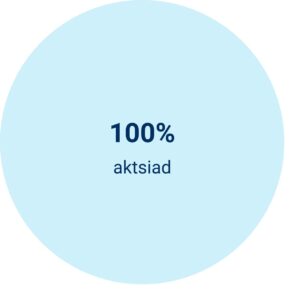
29.24% in iShares Developed World ESG Screened Index Fund
29.49% in Amundi MSCI World Screened UCITS ETF
29.49% in Xtrackers MSCI World Screened UCITS ETF 1C
You can click the links to read more about these funds and see how they’ve performed so far.
The rest of our fund’s stock investments go into an index fund that tracks emerging stock markets:
11.78% in iShares Emerging Market Screened Equity Index Fund (IE)
Why is this part separate? For some reason, the management fee of a fund that tracks the whole world index is higher than the sum of its components. The biggest difference is between funds for large markets (developed countries) and small markets (mostly emerging countries).
All the funds in our portfolio are listed in euros, but they hold assets that may be listed in US dollars, Japanese yen or some other currency than the euro. So if the euro strengthens against other currencies, the value in euros of many assets in our portfolio may fall. And vice versa.
In principle, Tuleva could also use funds that hedge currency risk. We don’t, because exchange rate swings are not the enemy of pension savers. Historically, the average long-term saver has neither gained nor lost anything by hedging currency risk. If hedging were free, we might as well do it. Unfortunately, nothing is free, and hedging costs the investor money. As with any other cost: if it doesn’t create value for savers, we don’t do it.
In September 2022, we introduced a change that excludes from the list of the world’s 3,000 largest companies nearly 200 companies that don’t meet the generally accepted criteria for sustainable and responsible investing (ESG). This doesn’t change the main goal of our portfolio, which is to achieve the average return of the world market, but it lets us take a small step towards taking into account and reducing the negative impact our investments have on the world’s natural and social environment.
At Tuleva, we believe it makes sense to save in a stock fund for as long as possible (in Estonian). The thing is, for people in Estonia the main risk of saving for retirement isn’t that the value of your savings falls, but that you save too little. Few of us earn so much that we could put together a sufficient sum without earning returns. In investing, risk and return go hand in hand. Although stock prices fluctuate more than bond prices, the long-term historical return of stocks has been considerably better than that of bonds.
Choose Tuleva World Stocks Pension Fund
Tuleva World Bonds Pension Fund
Tuleva’s second pension fund is very conservative and doesn’t invest in stocks at all. The law requires every pension fund manager to offer, among other things, a fund for people who can’t afford to have the value of their pension fund units fluctuate for the sake of a chance at better returns. This fund may suit you, for example, if you already have the amount you need for retirement and plan to withdraw your savings from the pension fund all at once. In that case, it’s also worth considering moving your assets to a pension investment account instead of a bond fund, to avoid a fall in their value. Although the value of bond fund units fluctuates less than that of a stock fund, swings in value can’t be ruled out, because the bond market is affected by changes in interest rates.
There are also people who get very nervous when the value of their investments fluctuates. By the way, if you are one of them, remind yourself that when you save for the future in small amounts, your purchases are nicely spread out and you don’t need to worry about short-term swings. Jack Bogle, the founder of Vanguard’s index funds, has this advice: “Don’t peek”, meaning don’t keep checking your pension account balance. But if you can’t hold yourself back, the bond fund may be for you, because an investor has no greater enemy than themselves panicking during a market downturn.
Tuleva World Bonds Pension Fund invests half of its money in the global bond index (Bloomberg Global Aggregate) and the other half in the euro-denominated bond index (Bloomberg Euro Aggregate Bond). Why this split?
On the one hand, the risk is lower when the money is spread between bonds denominated in different currencies. That’s what the global index does. On the other hand, short-term currency swings affect the prices in euros of funds that track the global bond market index. To hedge currency risk, the money would have to be invested in a euro-denominated bond index fund.
Here we use the simplest risk-hedging strategy there is: if you can’t decide which strategy is better, go half and half.
Tuleva’s bond fund is small compared to our stock fund. That affects its costs. So we keep a very simple portfolio of just four funds, each holding a quarter of our fund’s assets. 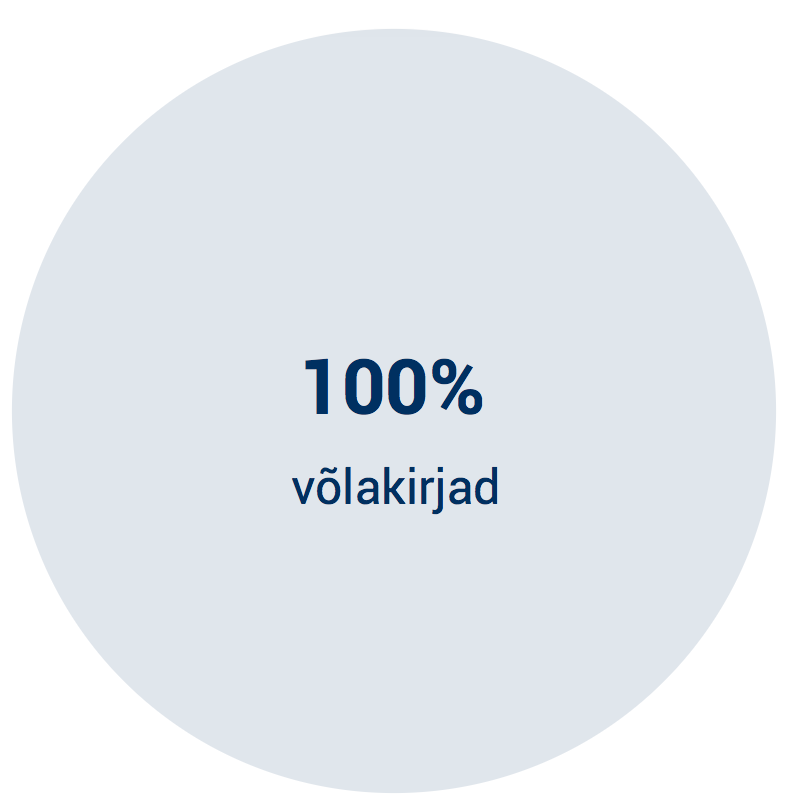
To track the euro-denominated bond index, we use two funds:
25% in iShares Euro Aggregate Bond Index Fund
25% in iShares Euro Government Bond Index Fund
This makes our fund slightly more conservative than the general index, as the share of government bonds is higher.
To track the global bond market index, we use:
25% in iShares Global Government Bond Index Fund
25% in iShares Euro Credit Bond Index Fund
This second fund invests in euro-denominated bonds of companies around the world, so it tilts more towards the euro area. As our fund grows, we will certainly get opportunities to track the world market more closely without excessive costs.
Tuleva’s pension fund fees are always among the most affordable in Estonia
The total cost, i.e. ongoing charges, of our funds is 0.28% a year. Why does this number differ from the fund management fee, which is 0.16% for our bond fund and 0.2% for our stock fund?
Just as when you buy a car you need to think about how much it will cost to run, when you choose a fund it’s worth looking beyond the purchase price at all the other costs you pay as an investor.
A pension fund invests its money further into other funds, which in turn charge their own management fee. Brokerage fees have to be paid for transactions made with the fund’s assets. In banks’ pension funds, these other costs can eat up as much of your money (in Estonian) as the management fee.
Essentially, the total cost shows how much lower our pension fund’s return is than the return of the indices we track (after taxes). The lower the total cost, the bigger the head start our investors have in growing their wealth.
Put simply: the lower the cost, the bigger the pension.
Since Tuleva’s Pillar II funds were launched in 2017, the state has also made other pension funds lower their fees significantly. Even so, Tuleva’s stock fund still costs at least 3 times less than the larger pension funds that invest in stocks, such as LHV L and XL (now LHV Ettevõtlik and LHV Julge), SEB 55+ and 60+, and the Luminor 16–50 and 50–56 pension funds. (5)
Learn to follow the ongoing charges, i.e. total cost, because the management fee alone only tells you half the story. You can follow the ongoing charges of all funds on the Pensionikeskus website, and you can check your own fund’s total cost in Tuleva’s calculator.
Our bond fund costs less than the two other most affordable conservative funds on the market: Swedbank Pension Fund Conservative and SEB 65+.
Costs matter especially for bond funds, because their returns are limited. The average yield of the bonds in a typical Estonian conservative pension fund portfolio is less than 1% a year after taxes. If the cost of such a fund is also close to 1% or more, you’re paying the entire return to the bank.
I, of course, transferred all my Pillar II pension assets to the Tuleva World Stocks Pension Fund. I exchanged all the pension fund units I had accumulated for Tuleva fund units and redirected my future contributions to Tuleva as well. Kristi Saare, chair of Tuleva’s supervisory board, did the same. She is also known as a leader of Investeerimisraadio and the Women Investors’ Club. Most of Tuleva’s founding members also save in our stock fund.
Happy pension saving!
Tõnu Pekk, Tuleva founder and fund manager
[email protected], 53 044 744
Transfer my Pillar II to Tuleva
Please note: this article was first written in 2017 and last updated on 7 October 2026.
Overview of Tuleva pension funds’ model portfolios (in Estonian).
- If you were born before 1983, you could choose until October 2010 whether to save in Pillar II or not.
- People who have joined Pillar II get a slightly smaller Pillar I pension than those who don’t save in Pillar II. For most people, this effect is small, and saving in Pillar II is still more beneficial. See for yourself how much Pillar II affects your Pillar I.
- According to S&P, 91% of US equity funds have underperformed the index over the past ten years.
- Until 2019, the law allowed pension funds to invest no more than 75% in stocks, so our fund used to put the rest of the money in bonds of the world’s largest governments. Today that restriction no longer exists, and we no longer buy bonds. We gradually sold the existing bonds for stocks, and since March 2023 our entire portfolio has been in stocks.
On 1 September 2022, we adopted the principles of sustainable and responsible investing, excluding from the portfolio companies that don’t meet the relevant criteria. Everything else stays the same. Read more here.
Read more about our funds: Tuleva World Stocks Pension Fund and Tuleva World Bonds Pension Fund.
